Project Buy
as a business as an individual universally across all productsProject details
Role: Design lead
Company: LinkedIn
Deliverables: AI prototype, Figma
Timeline: 2026
Status: Work in progress
Led experience design to unify payment identity across LinkedIn's product lines. Partnered with Product Managers, Engineers, Business, Finance, and other cross-functional stakeholders to define the payment profiles concept and establish a shared platform framework.
Delivered high-fidelity Figma designs alongside an AI-coded interactive prototype to bring the experience to life.
A platform initiative to create a unified payment identity for LinkedIn customers.
Set up once, recognized everywhere.
The problem
One customer, fragmented identities
From hiring to selling to learning, LinkedIn supports a wide range of customer needs across its products. Many of LinkedIn's most valuable customers use multiple products simultaneously and purchase on behalf of their businesses. Yet each product managed payment identity independently, with no shared context between them.
The same business was being treated as a different customer across products.
Their identity, billing context, and payment information are all managed independently in each experience.
LinkedIn has no way to recognize that the same person is purchasing for the same business, share data across products, or reuse payment details at checkout. Each product treats every purchase as a fresh start. And because each product line operated independently, with its own team, roadmap, and stakeholders, there was no natural owner for this problem. Solving it meant working across all of them.
Five distinct product lines, each with its own checkout and billing system. No shared layer connecting them.
Experience Demo
Before: Starting over, and over, every time
When a customer moved between LinkedIn products, there was no system that recognized them. The same company name, billing address, and tax ID had to be re-entered from scratch, even when LinkedIn already had that information from a previous purchase.
For most online SKUs, LinkedIn was not collecting detailed business information at checkout (except in India), missing the opportunity to build a reusable customer identity. In LinkedIn Ads, for example, a customer's payment details from one campaign are not carried forward to the next purchase.
Customer setting up a new campaign with no reusable payment information
The same billing setup, required twice, with no recognition between purchases.
The signal
The data confirmed what we already knew
The problem had accumulated for years. The fragmentation wasn't just a UX inconvenience. It was generating real operational cost and eroding customer trust at scale. Internal support data from one of the product lines (LMS) showed:
- ~16,400 billing-related support cases in a single quarter, and the same patterns repeated across the others.
- 29% of cases were customers unable to match payments to the right product or campaign.
- 4% were billing contact and company info changes, customers re-entering information LinkedIn already had.
"I've entered [my card] multiple times. It's the same card I entered before. I've been trying to resolve this for weeks. Why is it so hard to pay you and keep the account active? No other vendors have this issue. It's taking away from my business and yours."
— LinkedIn user, via customer support
The checkout issue was masking a platform gap
The instinct would have been to redesign the checkout flow: reduce steps, save a minute. But improving any individual flow wouldn't fix the root cause: there was no shared concept of a customer across LinkedIn's product surfaces. There was no shared layer to recognize the same customer across products.
The design challenge wasn't the flow itself. It was recognizing this as a platform design problem.
The reframe
Move from product-specific checkout fixes to a shared customer identity layer that the platform can recognize across every product surface.
The model: payment profiles
We introduced a new layer beneath the member account: reusable payment profiles that travel with the customer across products. A returning customer selects their profile at checkout instead of starting from scratch.
This also gives LinkedIn something it didn't have before: a unified view of who is purchasing. An enterprise customer investing heavily across multiple LOBs was previously invisible as a single entity. Payment profiles make that relationship visible, creating the foundation to better support customers and drive upsell and cross-sell opportunities based on their existing relationship with LinkedIn.
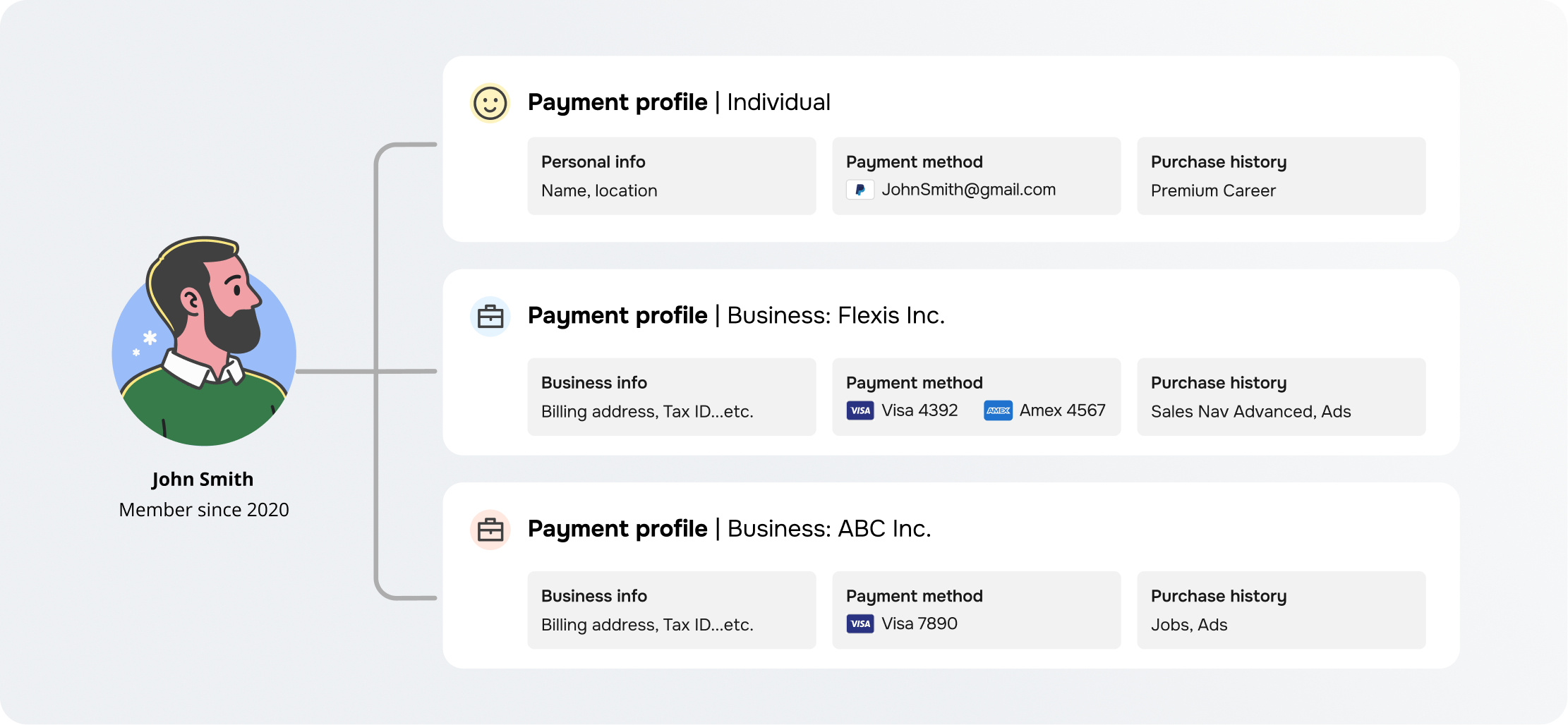
One member account, multiple reusable profiles, one per identity context. Each profile holds billing details, payment methods, and purchase history across products.
Each member can hold one individual payment profile for personal purchases, and one or more business profiles if they operate multiple businesses. As a business grows and is ready to expand into a larger organizational structure, a sales representative can step in to support the transition into an enterprise account.
Interactive prototype
After: The new buying experience when context travels with you
With the payment profiles framework defined, here's how the new experience comes together. First-time buyers go through a lighter setup with only the minimum information required. Returning customers can skip it entirely by selecting an existing profile.
To make the experience tangible for stakeholders and cross-functional reviews, I built an interactive prototype using AI-assisted coding tools. Rather than a static click-through, it simulates real purchasing flows with toggled states, dynamic profile context, and responsive behavior across SKU types. This let reviewers experience the logic firsthand, not just read about it.
Try both purchasing flows using the toggle below, same returning user, different product contexts. When you reach the payment step, you'll see their saved profile already waiting, no re-entry needed.
Returning User with payment profile context
Key design decisions
Map product type to a default purchase context
Rather than asking users to choose their context at every checkout, I explored SKU-to-profile mapping: each SKU is configured with a default purchase mode based on its intended buyer and business model.
Users can always switch. The default is intelligent, not prescriptive.
For example, Premium Career defaults to an individual profile, while Premium Business defaults to a business profile. Returning customers are matched to the right profile automatically.
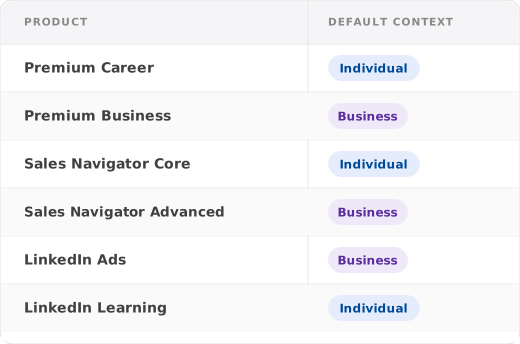
Reuse existing information wherever possible to build the customer relationship from day 1
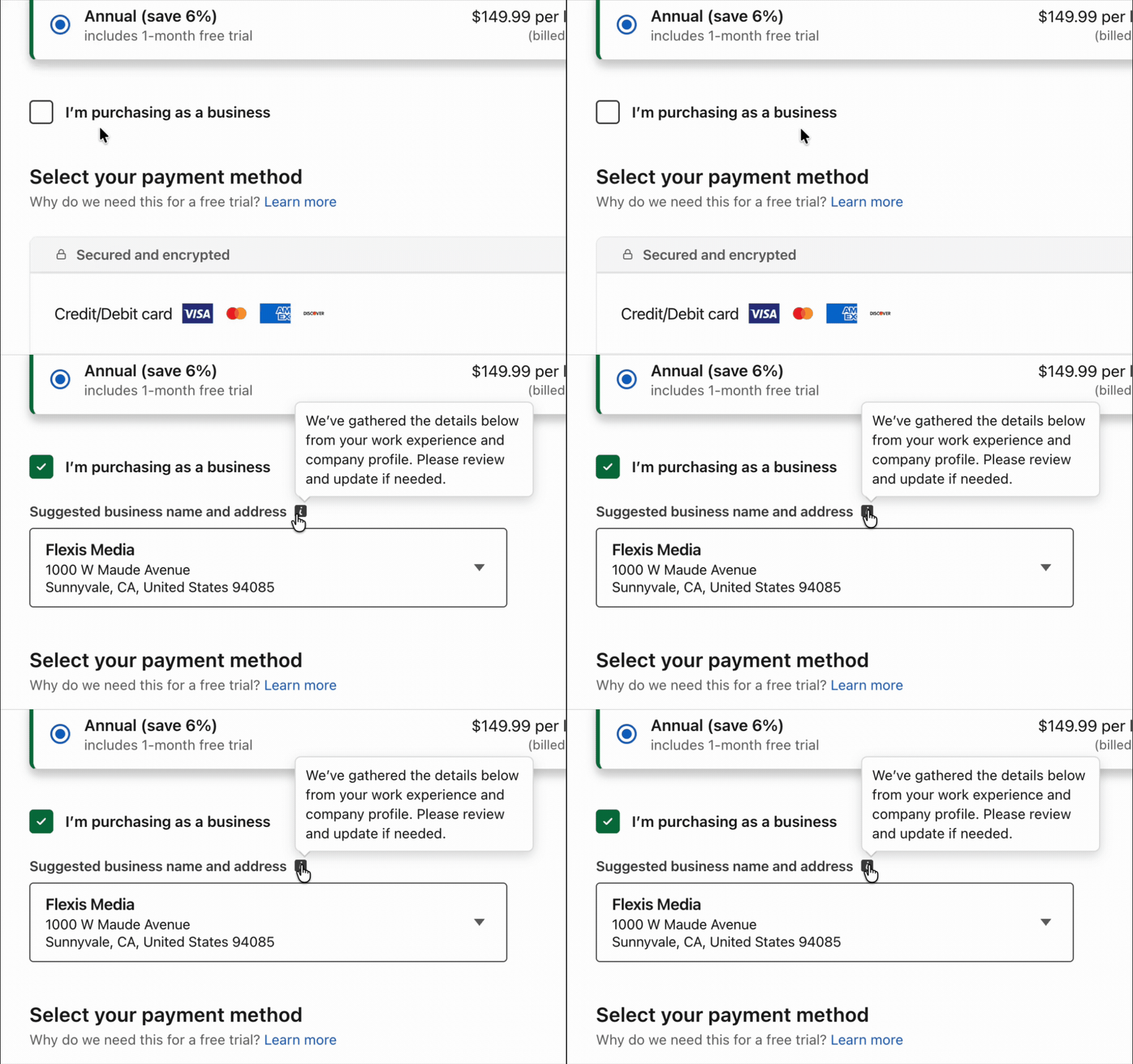
LinkedIn holds two sources of truth: the member's profile, which captures where they work, and the Company Page, which holds business information. Rather than treating a first business purchase as a blank form, the payment profile can be bootstrapped from existing LinkedIn data.
The customer confirms rather than re-enters. From day one, the experience signals that LinkedIn already knows who they are.
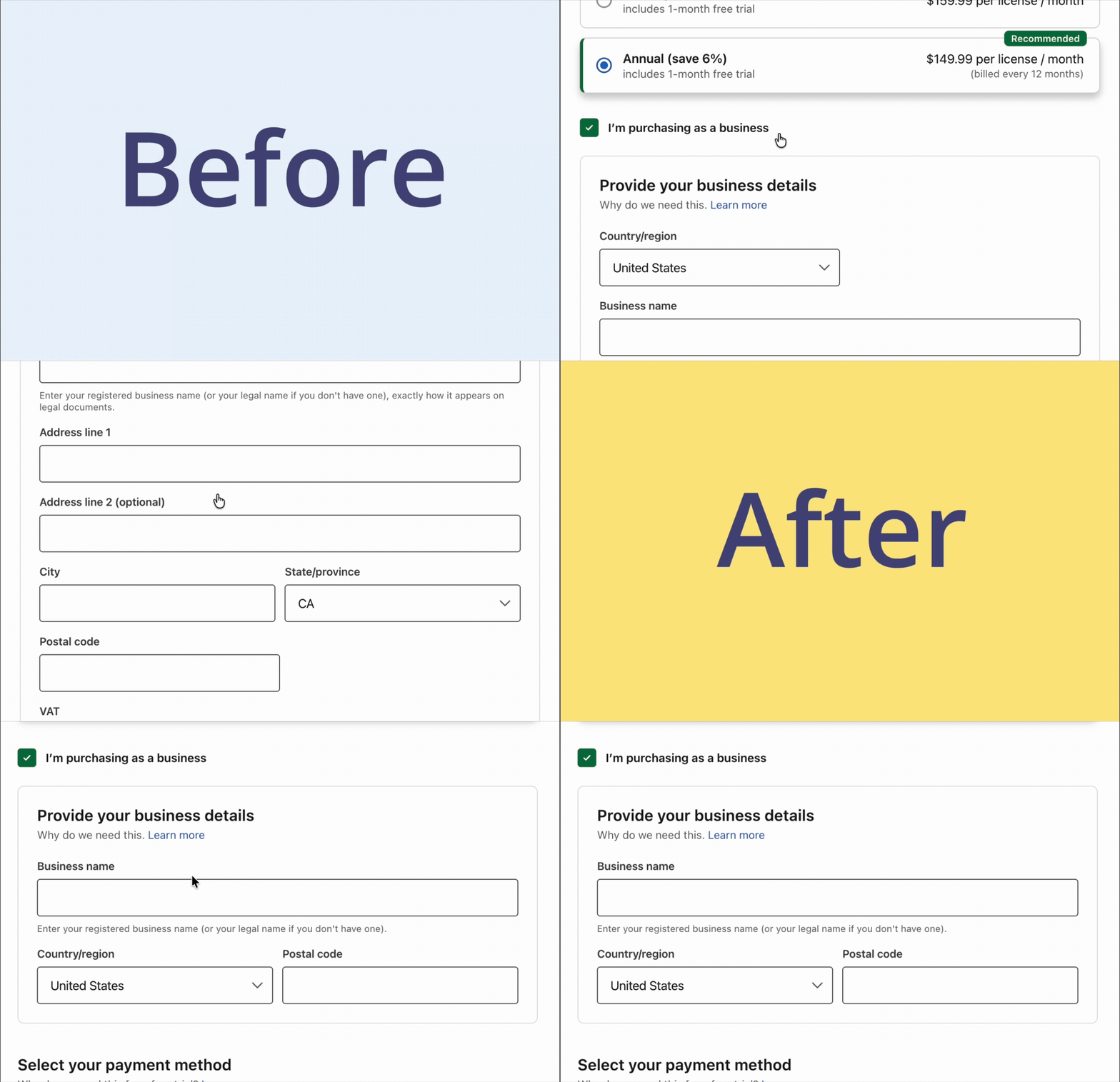
Collect the minimum upfront, gather more when it's needed
For buyers without an existing profile, the experience asks only for what that product requires. Additional details are gathered later, triggered by a post-purchase touchpoint or a compliance requirement. This keeps first-time setup as light as possible while building toward a complete billing identity over time.
Build a shared billing component with regional flexibility
We built a shared billing component as the foundation across all product lines. Each region could configure it for local tax rules, payment methods, and compliance needs. This gave the platform consistency without forcing uniformity, and made global rollout realistic rather than theoretical.
What this unlocks
For customers
Returning customers don't start over. The system recognizes who they are, what business they're buying for, and which payment method to suggest, especially for SMB owners managing multiple LinkedIn products at once.
For LinkedIn
Payment profiles make that relationship visible, enabling cross-sell recognition, better support, and a unified view of how customers engage across the portfolio.
Future vision: the enterprise wallet
Business profiles can eventually evolve into shared enterprise wallets: one payment identity accessible by multiple members of an organization with the right permissions. A procurement manager sets it up; the sales and marketing teams use it. This unlocks a B2B purchasing model LinkedIn's current architecture doesn't support.
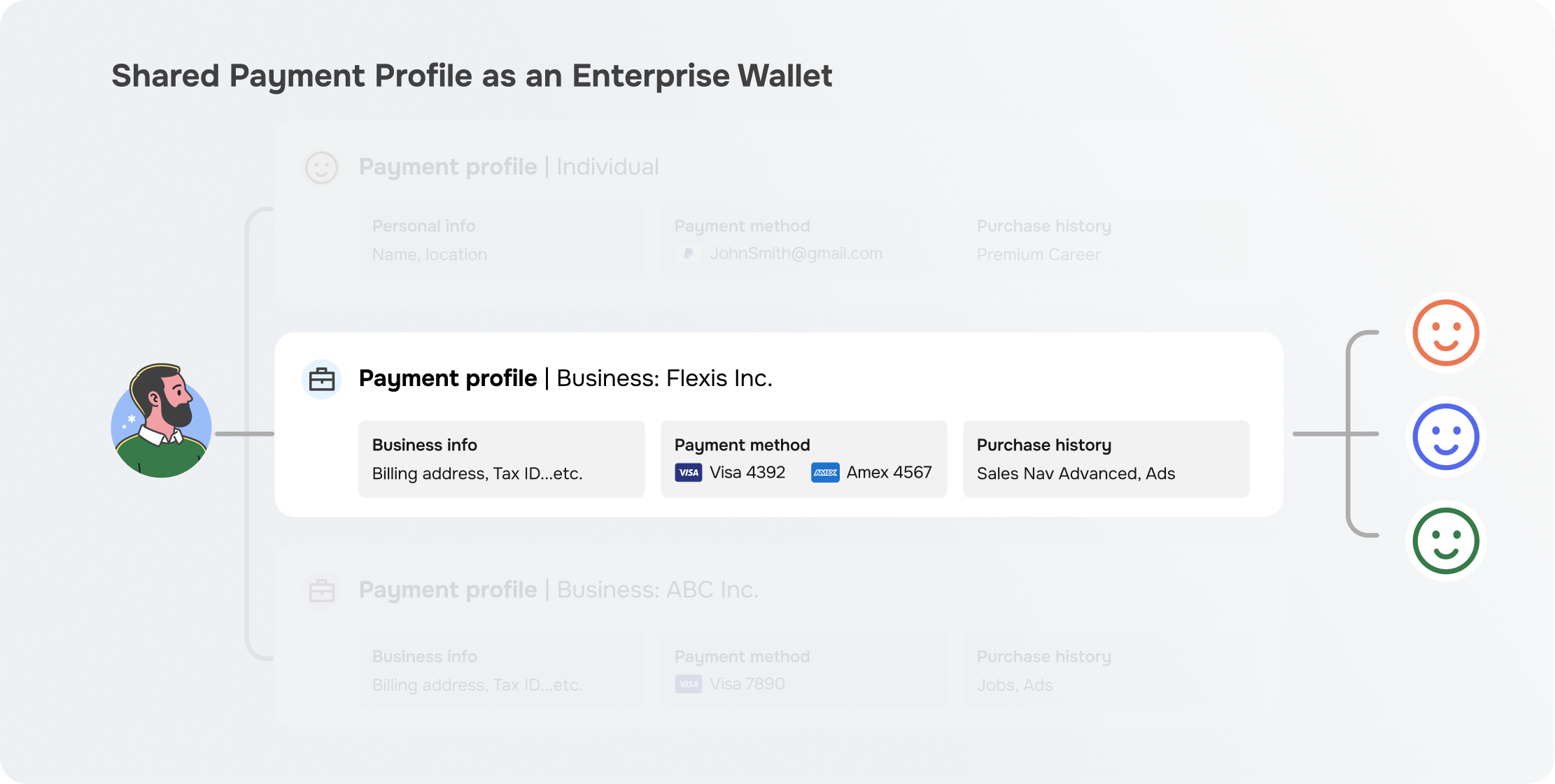
From an individual's reusable profile to a shared organizational wallet. The model is designed to grow into this.
Interactive prototype
Managing profiles: one place to see and control your payment identities
Beyond checkout, customers need a way to view, edit, and manage their payment profiles across products. This prototype shows the profile management experience.
Looking further ahead, when payment profiles can be shared across team members, the ability to designate payers and control access becomes essential. That future state lives in the Admin Center, where a billing admin can assign payer permissions and manage who is authorized to purchase on behalf of the organization.
Learnings
- The reframe was the hardest and most important move. Choosing not to redesign checkout, and instead naming it as a platform identity problem, changed the scope, the stakeholders, and what success looked like.
- Platform design is organizational design. A shared model only has value if multiple teams adopt it, and getting there required a different kind of design work.
-
Sequence the vision, don't try to build all of it at once.
The enterprise wallet is the right long-term destination, but the first thing to build is the foundation. Scoping to payment profiles (not shared wallets) meant we could move faster without waiting for organizational infrastructure that doesn't exist yet.
Why This Matters in My Portfolio
- Platform and systems thinking. Reframed a checkout friction problem as a gap in customer identity modeling, connecting UX to data modeling, platform architecture, and org design, not just interaction design.
- Identifying the right problem in ambiguity. A checkout redesign would have been the obvious move. Choosing not to do it, then designing the concept, model, and narrative from scratch with no existing pattern or single owner, was the harder and more valuable design decision.
- Cross-functional alignment. Drove buy-in across four product lines with competing priorities. Made the concept clear and compelling enough to move organizational direction.